Students at Apex Pinelands
Reframing education as an investment opportunity
Introducing the discussion, Russell Brueton, Wesgro’s chief marketing and strategic partnerships officer, outlined the agency’s focus on attracting investment into priority sectors, including education.
He highlighted Edu Invest, a public-private partnership initiative supported by Wesgro to crowd in private capital, facilitate CSI funding and improve access to quality education, particularly in low-income communities.

Caption: Apex Pinelands, a new school invested in by Edu Invest, powered by Wesgro, opened in January 2026.
De-risking education through better partnerships
Wendy Viljoen, senior manager for Edu Invest and a knowledge specialist on education at Wesgro, said one of the biggest barriers to investment is perceived risk rather than a lack of will. “When you invest in education, it’s a long game, and there’s a long wait before you see the impact,” she said, pointing to regulatory complexity as a key concern.
Government’s role, she said, is to provide policy certainty and enable service delivery. Investors must supply the right kind of capital, and education operators remain accountable for learner outcomes. When these strengths are misaligned, partnerships can become a source of risk rather than protection.
“We’re past the point where education is just a social concern,” she noted, adding that the aim is to ensure there are investment-ready and investor-friendly opportunities available.

Wendy Viljoen, senior manager for Edu Invest
Why catalytic capital matters
Tafadzwa Nyagano, CFO of the African Venture Philanthropy Alliance (AVPA), described catalytic capital as capital that enables investment to flow where it otherwise would not. While Gauteng and the Western Cape attract most education funding, the greatest need lies elsewhere.
“Catalytic capital is meant to be temporary and transformative,” he said, adding that the underinvestment in education and health “defies logic”, given their importance as economic infrastructure.
What makes education investable?
For Elmarie Cronje, Head of Transformation and Strategic Partnerships at UXI mPowered, the starting point is to stop pretending education is a “soft” investment. It is economic infrastructure – and should be treated as such.
She outlined three investor requirements: proof that a model works, a clear learner pathway linked to outcomes, and governance structures that protect capital.
“A bursary is not an investment unless it’s part of a structured, outcomes-driven system,” she said, noting that capital responds to structure rather than good intent.
Jana du Plooy, CEO of Apex Education, echoed the need for alignment, warning education operators to be selective about funding partnerships. For her, shared values around quality and excellence are as important as capital itself. Partnerships work best when there is “a shared value system around excellence, around belief that education is going to improve South Africa significantly”.

Wendy Viljoen, Tafadzwa Nyagano, Jana du Plooy and Elmarie Cronje
The ‘missing middle’ and unlocking scale
Nyagano pointed to the “missing middle” as a persistent challenge. Social enterprises seeking between R2m and R20m are often too small for traditional investors and too risky for banks, yet this is precisely the funding needed to scale sustainably.
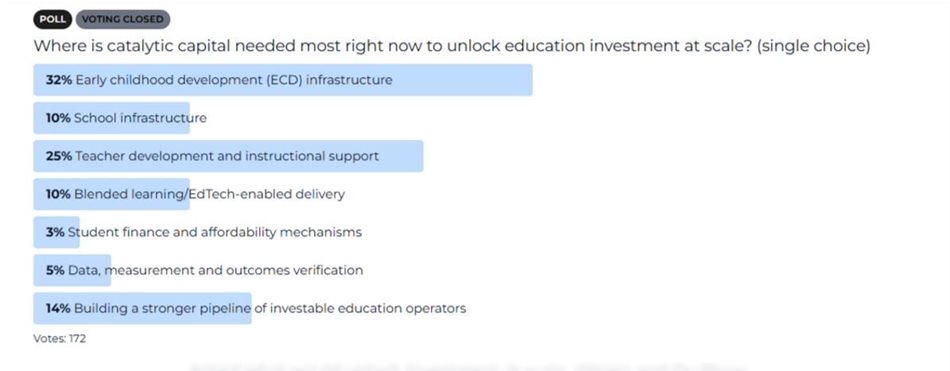
An audience poll suggested catalytic capital is most urgently needed for ECD infrastructure, followed by teacher development.
Asked what would unlock investment at scale, Viljoen and Du Plooy both argued for building a stronger pipeline of investable education operators. With around 80% of learners in public schools, Du Plooy argued that limited catalytic capital must be spent where it can have the greatest system-level impact.
Nyagano favoured investment in data, measurement and outcomes verification. “Without credible data, investors cannot price risk, governments cannot structure contracts, and capital will continue to stall,” he said.
Cronje argued “with my heart” for student finance and affordability mechanisms, reminding delegates that “the learner” remains the ultimate beneficiary. “Some things must last longer than the investment,” she noted.
As the discussion made clear, these priorities are interconnected. Catalytic capital is most effective when it strengthens the links between operators, data and funding – rather than backing any single intervention in isolation.
Watch the full video here and to learn more about Trialogue, visit their website.